A review of Acidification, Eutrophication, Heavy Metals and Ground-Level Ozone in the UK
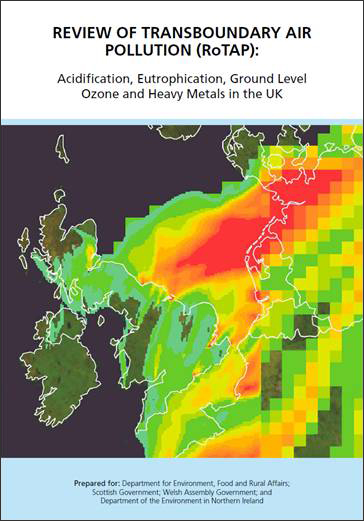
Defra have commissioned the Centre for Ecology and Hydrology (CEH) to coordinate a group of scientific experts to produce a Review of Transboundary Air Pollution (RoTAP). The RoTAP report aims to review the current state of rural air pollution issues in the UK, evaluate the extensive measurements of atmospheric pollutants and their effects, and produce a synthesis of current understanding which will be used to determine air quality policies.
The review focuses on the main chemicals causing acid deposition, eutrophication, ground level ozone and heavy metal pollution in the UK, namely sulphur dioxide (SO2), nitrogen oxides (NOx), ammonia (NH3), aerosols (particulate matter), heavy metals, nitric acid (HNO3) and ozone (O3). The RoTAP report reviews all of the current data available to the group on these pollutants and their contribution to acidification, eutrophication, ground level ozone and heavy metal deposition in the UK. The report covers:
1. Trends in emission, concentration and deposition of the main atmospheric pollutants.
2. Changes in the atmospheric processing of pollutants and their significance for policy.
3. Changes in the exceedance of critical loads and levels for all pollutants and UK ecosystems for which this methodology applies
4. Evidence of chemical and biological recovery from the effects of acid deposition, changes in the eutrophication of UK ecosystems, timescales to improve the heavy metal status of soils and changes in the effects of ground-level ozone on UK ecosystems.
5. The use of long range transport models to assess the prospects for further change in concentrations, deposition and ecosystem impacts.
6. The European and Global perspective on transboundary air pollution
The RoTAP report was launched at the Science Media Centre on Tuesday 19th June 2012. A pdf version of the report is available below.
If you would like to receive a hard copy of the RoTAP report, please contact the RoTAP secretary, Heath Malcolm, CEH, Bush Estate, Penicuik, Midlothian, EH26 0QB. Tel 0131 445 8554, email: hmm@ceh.ac.uk
| Attachment | Size |
|---|---|
| Summary for Policy Makers - Review of Transboundary Air Pollution (RoTAP) | 1.35 MB |
| Full Report - Review of Transboundary Air Pollution (RoTAP) | 20.13 MB |